



.svg)


















%20Collectors%20Image.png?width=143&height=143&name=ADC%20(Ambient)%20Collectors%20Image.png)


When the air in your plant is clean, everything works better - people, machines, and productivity, and choosing
the right dust collector air filters is one of the easiest ways to get there.
The filter you select directly impacts worker health, regulatory compliance with OSHA and NFPA standards,
and the longevity of your equipment. Whether you manage a manufacturing plant, oversee workplace safety,
or maintain production equipment, understanding how different dust collector filters perform helps you make decisions that help keep your system efficient and slash rising energy bills.
This guide walks you through everything you need to know about selecting OEM replacement filters and understanding how cartridge dust collectors and other systems work to keep your facility safe and compliant.
The Role of Air Filters in Dust Collection Systems
In any industrial dust collector, air filters capture particulates as contaminated air flows through the system. The process is straightforward: dust-laden air enters the collector, passes through filter media that traps particles, and clean air either recirculates into your facility or exhausts outside. Effective filtration controls respirable dust including fine particulate matter, reduces housekeeping requirements, and supports compliance with OSHA combustible dust guidance and NFPA standards now consolidated under NFPA 660.
High-performing filters stabilize differential pressure, keeping fans operating in their optimal efficiency range and reducing energy consumption. For many U.S. facilities, quality filtration serves as a frontline engineering control aligned with OSHA's hierarchy of controls for managing dust exposure. A.C.T. Dust Collectors' Nano-Elite filters remove 99.9% of particulates from the airstream, providing protection that meets demanding industrial requirements. When filters match your specific dust characteristics and operational conditions, they prevent premature equipment failure while maintaining the indoor air quality your workforce deserves.
Common Types of Dust Collector Air Filters
Understanding your filter options helps you select the technology that fits your application.
Each filter type offers distinct advantages for specific operating conditions and dust characteristics.
Cartridge Filters
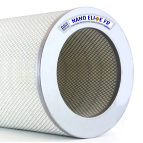
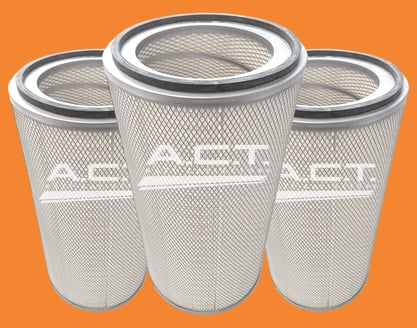
Cartridge filters use pleated media to pack substantial surface area into compact housings. This design reduces the air-to-cloth ratio, often improving efficiency while lowering the system footprint, ideal for facilities with limited floor space. A.C.T.'s cartridge filter options range from standard 80/20 cellulose blends to high-efficiency nanofiber media with MERV 15 ratings.
If your process generates fine or hazardous particulates - welding fume, plasma smoke, laser cutting emissions, grinding dust, or powder handling - cartridge filters are typically the optimal choice. The DCF22611 Nano-Elite filter delivers MERV 15 performance for extremely fine dust, smoke, and fumes, while the DCF22711 Nano-Elite Flame Retardant filter adds fire protection for combustible dust applications. For heavier particulate with good durability requirements, the DCF22412-1 Spunbond 100 and DCF22412-2 Spunbond 200 filters offer MERV 12 efficiency with temperature limits up to 225°F. These air filter cartridge options demonstrate how different media types address varying application needs.
Bag Filters (Baghouse)
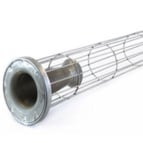
Baghouse dust collectors use long fabric bags that excel at handling higher temperatures, fibrous or heavier dust loading, and large air volumes. Bag filters typically provide longer service life than cartridges but require taller collectors and more space for maintenance. While changeouts take longer than cartridges, service intervals may be less frequent. Actual bag life varies by dust load, operating hours, and cleaning effectiveness.
Baghouses handle process temperatures up to 500°F (260°C) with specialty fabrics and work best for applications like woodworking, grain handling, foundry operations, and other heavy-loading scenarios. However, exact temperature limits are media-specific.
HEPA After-Filters
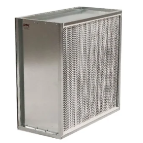
HEPA (High-Efficiency Particulate Air) filters capture 99.97% of particles at 0.3 microns, providing the highest level of air quality control. These filters typically serve as final polishing stages downstream of cartridge or bag filters.
If your process or local air quality requirements demand very high removal efficiency - common in pharmaceutical manufacturing, cleanroom operations, or facilities handling toxic materials, a HEPA after-filter may be necessary. A.C.T. offers HEPA filter options for applications requiring this level of protection.
Note: HEPA usage should be guided by risk assessments and process needs - refer to your facility's dust hazard analysis for specific requirements.
Specialty Media Filters
Some dust collector applications demand specialty filter media designed for unique challenges. Flame-retardant coatings protect against sparks in metalworking and grinding operations where combustible dust hazards exist. PTFE membrane filters resist sticky or oily dusts that would blind standard media. High-temperature fabrics withstand extreme heat without degrading.
The right specialty media reduces filter blinding, extends service life, and controls differential pressure more effectively. Explore A.C.T.'s full range of OEM replacement filters to find media options suited to your specific operational requirements.
Key Factors When Choosing the Right Filter
Selecting optimal dust collector air filters requires careful consideration of several critical factors unique to your operation.
Dust Type and Particle Size
Begin by understanding what you're collecting:
- Fine smoke and fumes from welding or laser cutting benefit from pleated air filter cartridge media with high MERV ratings.
- Fibrous materials or high-load dusts often suit bag filters better. Some processes may need HEPA after-filters to meet exposure limits for hazardous materials.
- If you handle combustible dust materials like wood, metal, grain, sugar, or many plastics, ensure your filter media and system design support your facility's dust hazard analysis and align with NFPA 660 requirements.
In addition, the particle size distribution in your dust stream determines which filter efficiency you need: sub-micron particles require different capture mechanisms than 10-micron or larger dust.
Airflow and Volume Requirements
Your collector, ductwork, and fan were sized for specific CFM (cubic feet per minute) and air-to-cloth ratio targets. Installing filters with insufficient media area raises differential pressure, forcing your system to consume more energy while reducing capture efficiency at dust sources. Pleated cartridge filters typically provide more media per cubic foot of collector space than bags, helping maintain lower pressure drop in compact installations.
Regulatory and Corporate Standards
OSHA’s National Emphasis Programs (NEP) are designed to reduce risks in industries where workers face greater exposure to serious hazards. These programs help identify problem areas and ensure workplaces follow the safety practices needed to protect both people and the environment.
OSHA’s NEP keeps combustible dust hazards on the radar, and NFPA 660 provides the consolidated US standard. Some applications may require HEPA after-filters to reduce emissions downstream of the main collector, based on your risk assessment and local requirements.
Note: EPA National Ambient Air Quality Standards focus primarily on outdoor air - apply your specific site policies and state regulations accordingly.
Maintenance Frequency and Life-Cycle Cost
Look beyond initial purchase price to understand the total cost of ownership.
Consider expected service life, pulse-cleaning effectiveness, and downtime required for changeouts. For many plants, a filter that maintains lower differential pressure longer - with reliable availability and quick replacement procedures - wins on total cost even at higher unit prices. A.C.T. filters are built to OEM specifications using quality materials, extending service life while maintaining consistent performance.
If you're uncertain which filter best fits your application, start with a conversation. A.C.T.'s team can review your dust properties, operating temperature, humidity levels, and production hours to recommend filters that meet your goals for safety, efficiency, and compliance. For a dollars-and-sense lens, see Filter Price Comparison and How to Calculate Total Cost of Ownership.
Must Read: Industrial Dust Collector Filters: A Guide to Maintenance
Signs You Need Filter Replacements
Recognizing when filter replacements are necessary prevents system failures and maintains air quality. Watch for these indicators:
Rising differential pressure at steady production rates signals that filters are loading with dust. A gradually climbing baseline pressure suggests media is becoming clogged or blinded, even if the pulse-cleaning system operates normally. Reduced airflow or capture efficiency becomes apparent when hoods no longer "pull" as effectively or dust hangs in the air near workstations. Visible dust leaks at the clean-air side of the collector, around filter seals, or at the exhaust stack indicate filter damage or saturation. More frequent downtime for manual pulse cleaning or housekeeping suggests filters have reached the end of their effective life.
When you observe these symptoms, inspect your filters, confirm you're using the correct fit and media type, and plan filter replacements before production suffers or compliance issues arise. If you need more insights, refer to A.C.T.'s maintenance guidance.
FAQs About Dust Collector Air Filters
How long do dust collector air filters last?
Service life varies significantly based on dust type, loading rates, operating hours, and cleaning system effectiveness.
Cartridge filters in light-duty applications often run for many months or even years, while heavy-loading operations may require replacement every 6-12 months. Bag filters frequently last one to three years with proper sizing and pulse-cleaning. Rather than relying solely on time-based schedules, track differential pressure and schedule changeouts before performance degrades.
For specific guidance on your application, contact our team to discuss your operating conditions.
Can I use aftermarket filters in my dust collector?
While aftermarket filters may physically fit your collector, they can compromise system performance and void warranties. Filters vary in media quality, pleat count, efficiency ratings, end cap construction, and gasket materials. Poor fit risks air leaks and higher differential pressure, reducing capture efficiency and increasing energy costs.
What happens if I don't replace filters on time?
Delayed filter replacements create cascading problems throughout your operation. Clogged filters restrict airflow, forcing fans to work harder and consuming excess energy, often measurable in your utility bills. Poor dust capture allows particulates to escape into your facility, creating housekeeping burdens, health hazards, and potential OSHA compliance violations, especially for combustible dust environments.
In addition, overloaded filters can rupture, releasing accumulated dust back into your workspace and potentially triggering dust cloud deflagration risks in certain scenarios. Downstream equipment suffers damage from inadequate dust removal. The combined costs of these issues far exceed timely filter replacement expenses.
How do I know which filter fits my collector?
Filter selection depends on your collector model, application requirements, and dust characteristics. A.C.T. maintains detailed specifications for all systems. Start by checking your OEM replacement filters page with your collector model number and current filter dimensions. For less common configurations or custom applications, contact A.C.T.'s team with your dust collector’s number and application details.
Choosing A.C.T. Dust Collectors for Your Air Filter Needs
A.C.T. Dust Collectors provides durable, USA-made filters built to OEM specifications, with media options engineered for your specific application. From flame-retardant cartridges for combustible dust to high-temperature bags for hot processes to HEPA after-filters for cleanroom requirements, A.C.T. offers comprehensive solutions for demanding industrial dust collector applications. The company's Nano-Elite filters deliver MERV 15 performance, removing 99.9% of particulates while maintaining optimal airflow and energy efficiency.
Our goal is straightforward: improve air quality, support your OSHA and NFPA compliance strategies, and maximize system uptime. We stock common filter sizes for rapid shipment - often shipping within one week through our ready-to-ship program - minimizing production downtime when you need replacements.
Ready to ensure your dust collector operates at peak efficiency with the right dust collector air filters? Talk to our team about selecting the optimal filters for your facility or explore our complete line of dust collection systems and filter options to find the perfect match for your application.
.png?width=240&height=91&name=ACT%20Dust%20Collectors%20Logo%20Solid%20White%202020%20(1).png "ACT Dust Collectors Logo Solid White 2020-2")
.png?width=148&height=149&name=usa-manufactured-dust-collectors%20(1).png "United States Flag")