Frequently Asked Questions
What type of industrial dust collector is right for my facility?
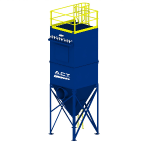
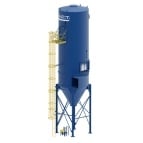
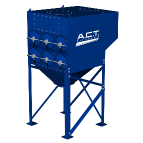
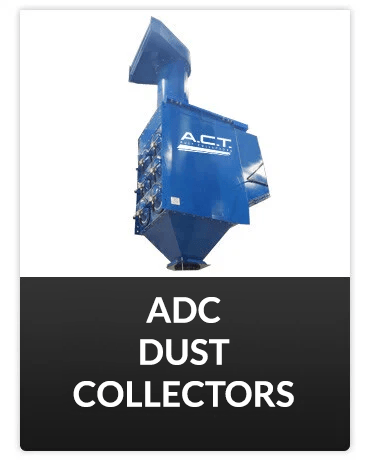
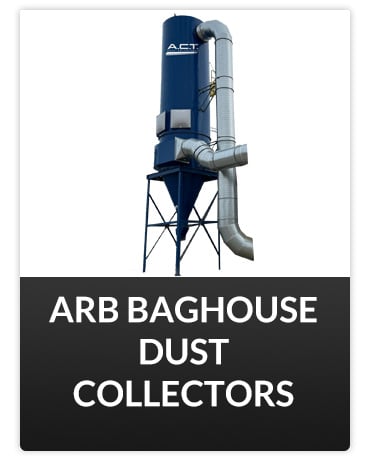
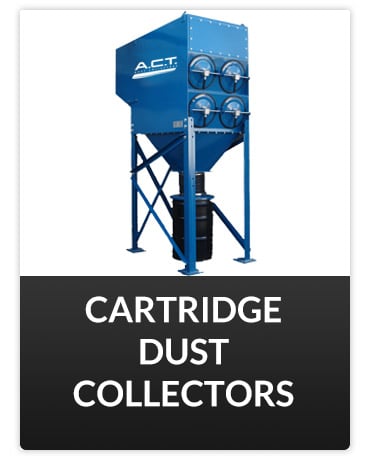
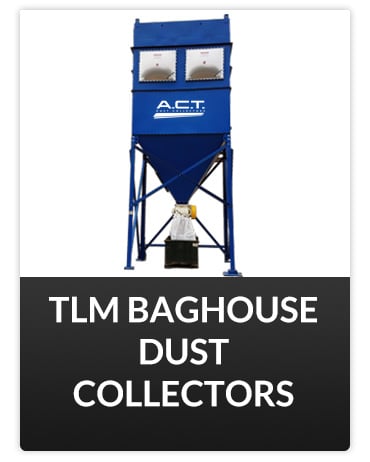
For most industrial facilities, a cartridge dust collector is the right starting point for industrial dust collection, since it handles the widest range of dust and fume types with the smallest footprint. Facilities with heavy, continuous dust loading like woodworking or grain handling should look at baghouse systems instead, since fabric filters hold up better under that volume.
What's the difference between a commercial and industrial dust collector?
Commercial and industrial dust collectors both capture airborne dust and fumes, but industrial systems are built for continuous, high-volume operation across manufacturing environments, while commercial systems typically serve lighter-duty applications with less constant dust generation. A.C.T. Dust Collectors builds industrial-grade systems suited to facility-scale production rather than occasional use.
Can one dust collector serve multiple machines or work areas?
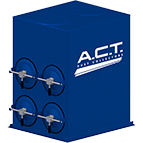
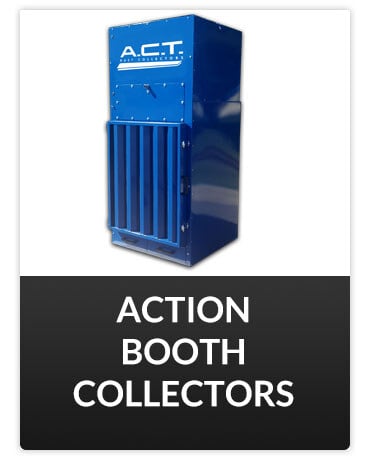
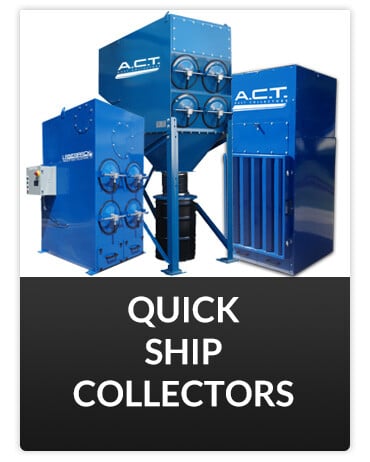
Yes. Centralized systems, such as cartridge or baghouse dust collectors, can serve multiple machines or work areas through shared ductwork, which simplifies maintenance and reduces the number of units a facility needs to install. Source-capture systems like the ACTion Booth are better suited to isolated, single-station applications.
How do I determine the right CFM for a dust collector?
The right airflow, measured in cubic feet per minute (CFM), depends on the number of machines connected, the type of dust being captured, and the ductwork design moving air to the collector. Facilities running multiple machines simultaneously need a system sized for combined airflow, not just the largest single machine.
What makes a dust collector suitable for high-performance industrial use?
A high-performance industrial dust collector maintains consistent airflow under continuous operation, uses filter media rated for the specific dust type, and includes automatic pulse cleaning to prevent filter loading from reducing performance over time. Systems built for industrial working environments are engineered to run reliably across extended production schedules, not short-duty cycles.



.svg)
















%20Collectors%20Image.png?width=143&height=143&name=ADC%20(Ambient)%20Collectors%20Image.png)



.png?width=240&height=91&name=ACT%20Dust%20Collectors%20Logo%20Solid%20White%202020%20(1).png "ACT Dust Collectors Logo Solid White 2020-2")
.png?width=148&height=149&name=usa-manufactured-dust-collectors%20(1).png "United States Flag")